Heritage Group Tries to Save Historic Snooker Hall

The Victorian-era Friendly Societies’ Hall in Camden Road could be saved from demolition after a dramatic intervention by the Tunbridge Wells Civic Society.

The Society has made an emergency application to add the 150 year-old Hall to the national list of protected buildings, which would stop the Borough Council knocking it down.

The Planning Secretary of the Civic Society, Alastair Tod, told Southborough News that the Society had prepared “a good case” and was doing everything it could to protect the building, which is currently a flourishing snooker club with 400 members (see below).
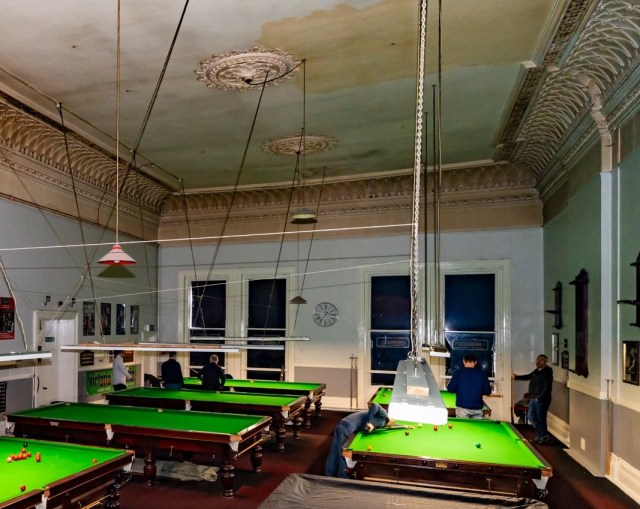
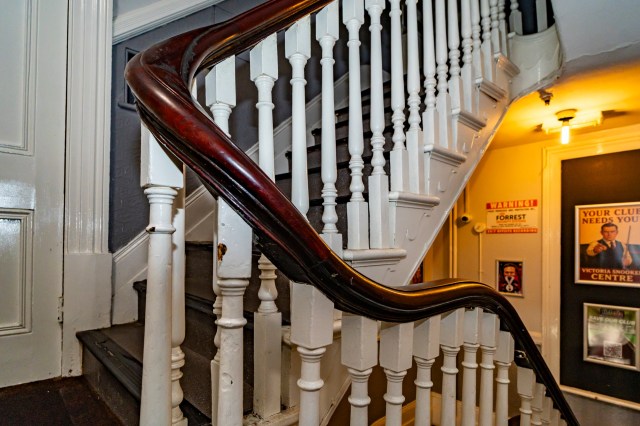
Alastair Tod said the building is “remarkable inside” and it was a “revelation” to him when he first visited.

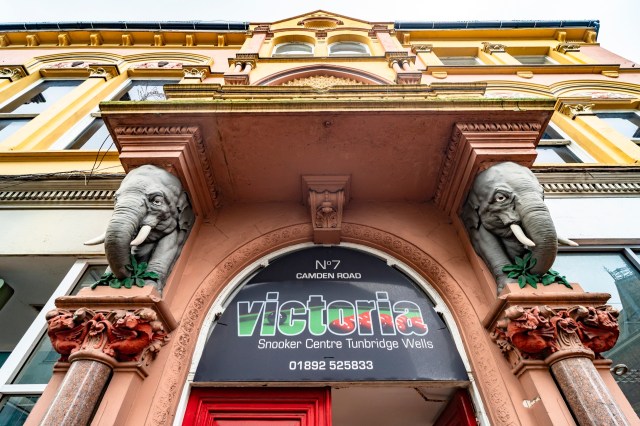
He said it was an “absolute shock” when the council revealed recently it intended to demolish the building, leaving only the facade on Camden Road. (Pictures kindly supplied by Sarah Mott.)
Several Tunbridge Wells Borough Councillors have told Southborough News that they hope the listing bid is successful.

But the Liberal Democrat-run Tunbridge Wells Borough Council appears not to have changed its view, arguing that the interior of the hall all needs to be demolished to make space for a luxury cinema operator.
The Liberal Democrat MP for Tunbridge Wells, Mike Martin, said: “The Liberal Democrats and I were elected with a mandate to revitalise the Tunbridge Wells town centre, and that’s exactly what we’re doing.”

Mike Martin continued: “I’m delighted with the Borough Council’s plans to deliver brand new purpose-built retail, hospitality and leisure units, while also maintaining the town centre’s heritage and historic facade on Camden Road.”

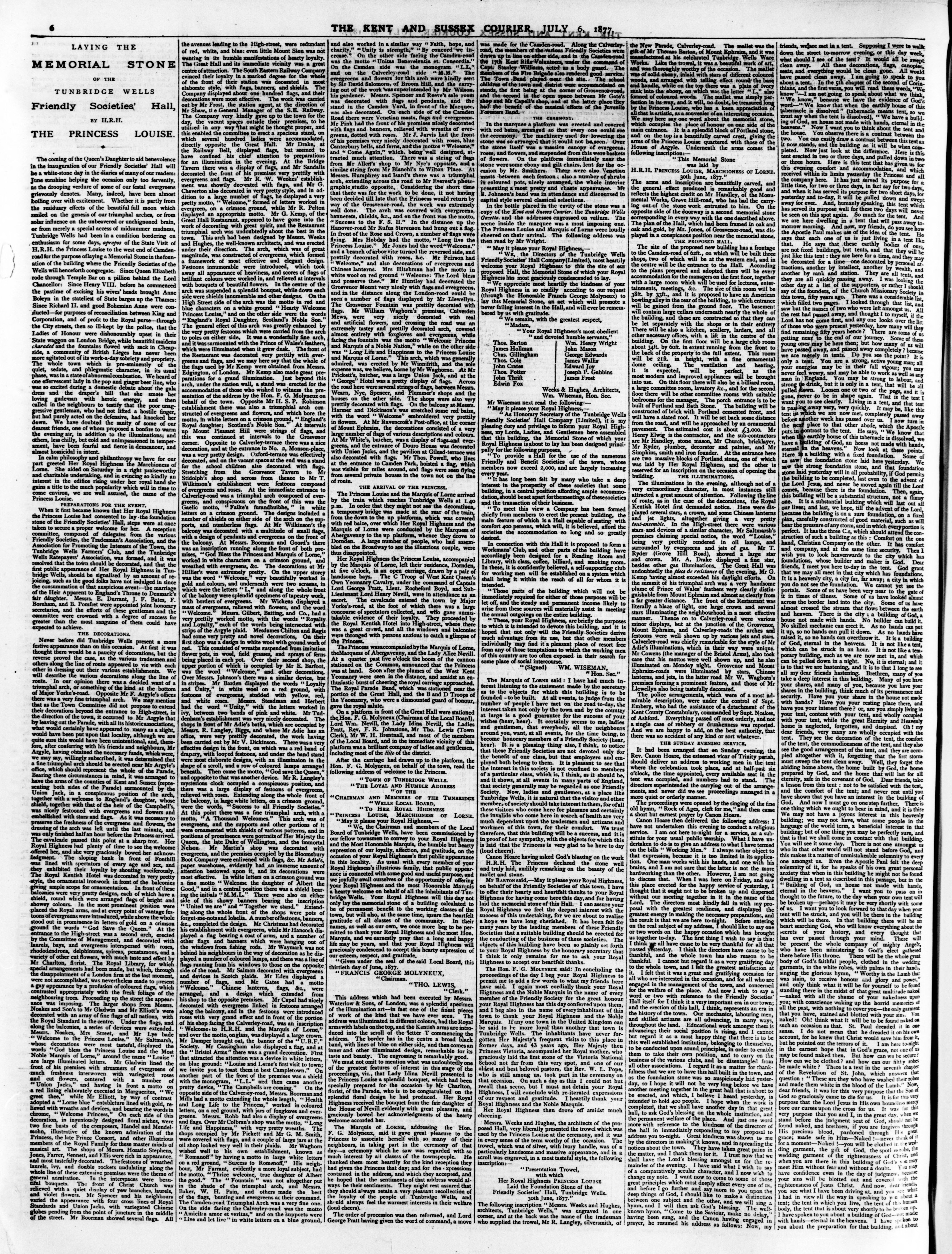
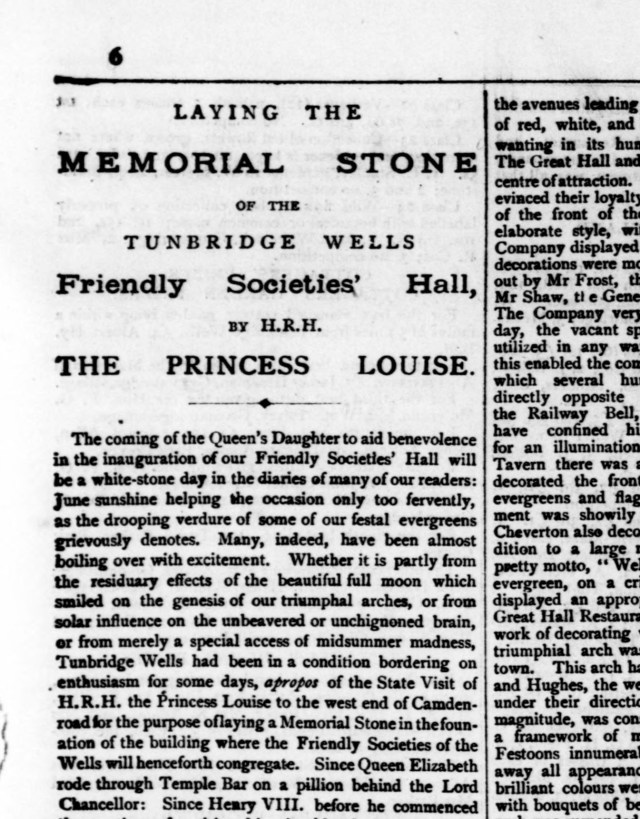
The Friendly Societies’ Hall memorial stone (marking the start of building work) was laid by one of Queen Victoria’s daughters, Princess Louise, on 30th June 1877. An article from the time in The Courier published a full page of detail on how the town came to a standstill for the royal visit, with many residents “boiling over with excitement”. (see below).
This is a picture (below) of Princess Louise from four years later. She was Queen Victoria’s sixth child, an artist, sculptor and proponent of women’s rights.

According to the Courier report, as she laid the stone, Princess Louise was observed “audibly remarking on the beauty of the stone and mallet”. The mallet had been made by local craftsmen of ebony and ivory. The trowel she used was made of silver with an ivory handle, which was also made by a local craftman.

The Courier article said the planned Friendly Societies’ Hall would seat 400 people and the building would include a Reading Room, stating: “It is confidently believed, a self-supporting club for working men will be established on a system which shall bring it within reach of all for whom it is intended.”

Alastair Tod also said the Civic Society’s architects had demonstrated that a new boutique cinema could still be built on the RVP site even if the whole Friendly Societies’ Hall was left in tact.

An aerial view illustrating the council plans for adding more modern retail space to the RVP are shown below:
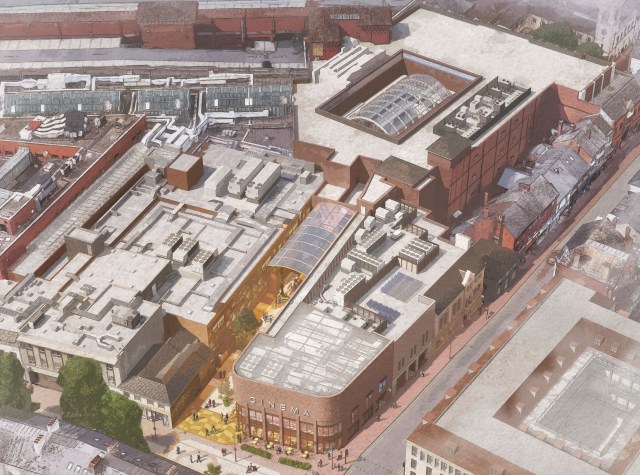
The scheme involves expanding the Ely Court footpath (in yellow above) to a width of 10 metres and setting back the building line by 5 metres. Alastair Tod of the Civic Society said if those elements were changed, the Friendly Societies’ Hall could be preserved without affecting their preferred operator’s desired layout for the luxury cinema and also still leave space for an expansion of food outlets.

It is understood that the boutique cinema will have three screens and be a much higher priced venue than the Knight’s Park Odeon, with luxury seats to replicate the comfort of being at home. The council has a “preferred operator” which has apparently made such a luxury cinema business model work in other towns and which has laid out the cinema designs it thinks will work.

Alistair Tod said the Society had submitted a detailed application to try to persuade English Heritage and the Department for Culture Media and Sport that a listing should be granted.
Alistair Tod said: “It is very important, historically, because it was the Friendly Society’s Hall, which meant that any number of voluntary, mutual help organisations got together in Victorian times to build and operate this centre for all their social activities. So it was self-help, Victorian-style writ large, and it’s significant, I think, nationally, as well as locally, as well as being rather a fine building.” 

He continued: “That side of Camden Road is in the Conservation Area. And therefore, qualifies for protection under the council’s own plans. And it’s an absolute shock to discover that they want to pull it down. Preserving the facade is a very poor substitute for preserving the building.”

One possible reason for the Council to demolish the Hall is that money might need to be spent on maintaining the Hall. But Alastair Tod thinks that is no reason to justify demolition.

He said: “I think it’s probably a long backlog of maintenance. The Hall is by no means falling down. It’s in reasonable nick, and it’s in, of course, continuous operation, continuous occupation.” 

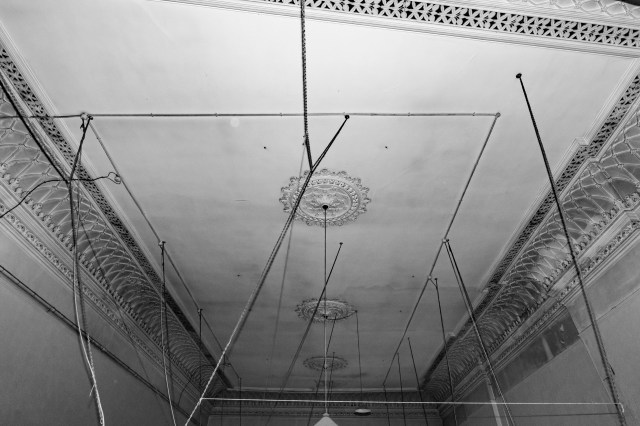
“Architecturally, the interior is very fine, especially the main hall, where the snooker tables are, has a very fine ceiling, and there are other spaces in the building, which are also worth preserving. 
He continued: “It was built in the 1870s by the friendly societies, who were these numerous self-help organisations, which already existed in the town, and they came together to build themselves a rather splendid headquarters – somewhere where they could meet, have lectures and so on. It had a bar and the original plans showed it having a cookery school. It was self improvement, learning skills, supporting one another.”

A full explanation of the Council’s Plans were published last week on Southborough News:
https://southborough-news.com/2026/03/13/demolition-likely-for-historic-corner-of-camden-road/

Asked about the broader wisdom of the Council’s plans to take on a debt of up to £ 68 million for its RVP shopping centre expansion plans, Alistair Tod said: “Well, it’s supposed to pay for itself, by adding to the lettable space, which there is at present in the RVP. It’s a very commercially minded development.”

He continued: “They’re maximising lettable space. So, if it does what it’s designed to do, then it wouldn’t be a burden long term on the council. But it’s a big sum of money, and there is a risk involved – obviously – a risk that it wouldn’t work. They have a lot of vacant space. They hope that by rejuvenating the centre, they can occupy it.”

Details of a petition to save the snooker club – signed so far by 4,800 people – are here:
https://c.org/wDcWGyb9Hv

The latest council consultation only lasted 11 days, ending this weekend. Residents can question council officers at the Royal Victoria Place Shopping Centre (between iStore and Kent Relief, a few doors down from Primark) on Saturday 21st March from 10am to 2pm.

You can send a consultation response from this link:
https://rvpfuture.com/

The fascinating full Courier report on the Friendly Societies’ Hall opening can be downloaded here:

Demolition Likely for Historic Corner of Camden Road

The Borough Council says it wants to spend up to £ 68 million of taxpayers money on new buildings including a three-screen “boutique” cinema in the centre of Tunbridge Wells.

The development plans would also see the end of the Victoria Snooker Centre in Camden Road which has hosted exhibition games featuring famous names like Ronnie O’Sullivan.

The Tunbridge Wells Borough Council plans are part of its efforts to revive the struggling Royal Victoria Place Shopping Centre, which it now owns.

The corner of Camden Road and the pedestrianised part of Calverley Road would be demolished and transformed into the modernist design shown below:

The corner was occupied by White Stuff chain in 2012 (see below) before the area was allowed to become derelict.

The Liberal Democrat-run council says it has worked with the community to “reimagine Royal Victoria Place as a more vibrant mixed-use destination, bringing together shopping, food and beverage, community leisure spaces and new homes.”

Six years ago a major development scheme devised by the then Conservative-run council to build a new theatre in Tunbridge Wells was abandoned after a rebellion by the party’s own councillors who thought the £100 million scheme would be a huge financial burden on council tax payers.

The council aims to get planning permission for the new scheme (see below) by the summer and get full council approval to go ahead by the autumn.

The scheme’s plans to demolish the Victoria Snooker Centre were reported on by the BBC’s Phil Harrison in December.

Jerome Bowman, who is campaigning to save the centre told the BBC: “Losing the club would mean losing a vital community hub, local heritage, a place to play one of Britain’s most popular sports and a place filled with shared memories.”

Read more here:
https://www.bbc.co.uk/news/articles/cq5q64zq791o

Details of a petition to save the snooker club – signed so far by 4,700 people – are here:
https://c.org/wDcWGyb9Hv

The facade of the Camden Road entrance to the snooker centre will be retained (see plans below), but everything behind it will be demolished.

The outside currently looks as shown below:

The snooker centre is the current occupier of the Friendly Societies Building designed in 1877, which is a key part of the town’s history.

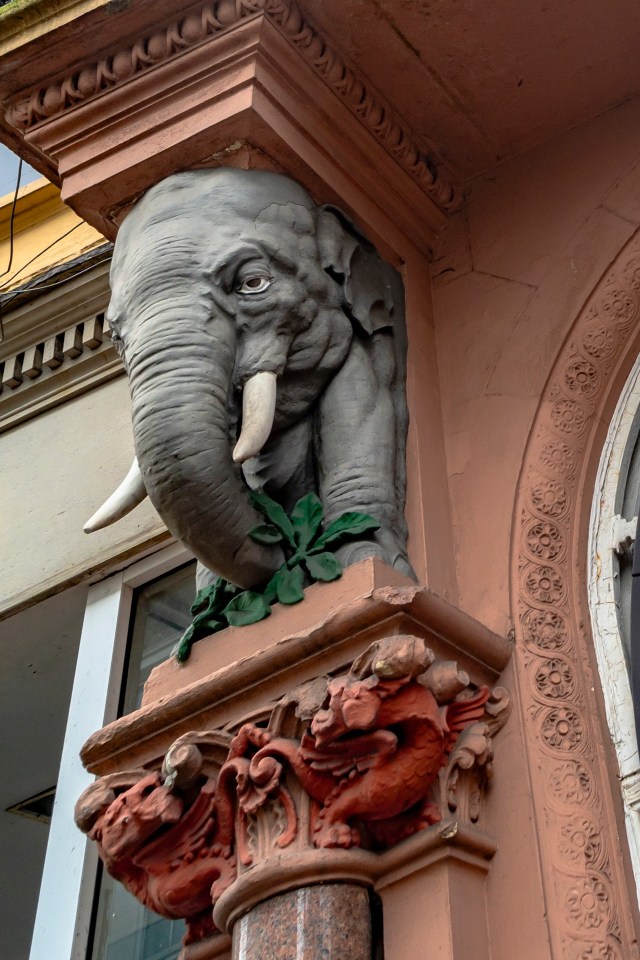
The elephant heads either side of the door are part of the coat of arms of the Camden family, which was involved in the development of the town in the 1850s. Pictures of the ornate ceilings on the inside of the snooker centre – which will be lost – are shown below.

This was the council’s response to the question: Why not simply refurbish the current buildings?

“The Council has carefully considered whether refurbishment alone would be viable. However, the existing buildings cannot accommodate key elements of the proposed scheme – including the much-in-demand town centre cinema – without substantial alteration. As a result, parts of the buildings, particularly to the rear, would need to be removed to allow the new uses to be delivered while retaining and restoring the historic Camden Road frontage of the Friendly Societies Building.”

The developers say their scheme will: “draw on local materials, proportions and detailing to reinforce the town’s distinctive identity while delivering active frontages at ground and first floor and retaining important historic features.”

The council says a cinema would “respond to long-standing demand”, make efficient use of a constrained site and will boost the “top of town’s evening economy.” The cinema would be located above five new “family-focussed” restaurants.

Its statement argues that: “income from new tenants, as well as other sources such as car parking and business rates, will help repay the government loan funding the scheme, helping to protect the council’s investment.”

Meanwhile another part of the development, Palm Court, is also set for a big changes to its appearance (shown below):

The developers say: “A new covered roof will enclose the existing atrium void – a contemporary interpretation of the Victorian Palm House structures that inspired the space’s name.”

The council statement continues: “The former basement food court will be repurposed as a new anchor leisure destination linked directly to the new cinema and restaurants. Additional community-focused leisure space could also be delivered to the north of the site, with an entrance and active frontage onto Market Square.”

The latest consultation lasts just 10 days. Plans are available for viewing at the Royal Victoria Place Shopping Centre (between iStore and Kent Relief, a few doors down from Primark) between March 12th and March 23rd. More details at this site:
https://rvpfuture.com/

Planning experts will be available to answer questions on: Friday, March 13 from 2pm to 5pm; Saturday, March 14, from 10am to 2pm; and Saturday, March 21, from 10am to 2pm.

The council says more than 800 people took part in the first phase of engagement on development of the “Ely Court” and “Palm Court” areas. There were 434 detailed feedback responses. This compares with 4,600 people who say they want the Snooker Hall retained.

Tunbridge Wells Borough Council bought back the lease for the shopping centre from British Land in 2023. The Council says it has already made progress in reducing vacancies and attracting new businesses, including Søstrene Grene and Primark. 

Regulator’s Response to SE Water Failings is “Woeful”

A group of Tunbridge Wells residents has attacked the water industry regulator for not taking strong enough measures to secure water supplies in the town.

The water regulator OFWAT said on Thursday it planned to fine South East Water £22 million for supply disruptions in a period ending three years ago.

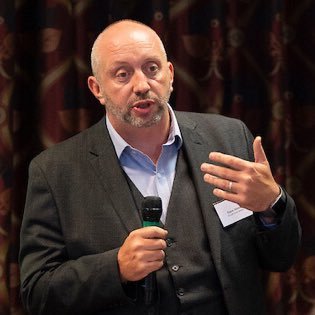
But local resident Jonathan Hawker (pictured below) of the group, Dry Wells Action, said: “We are extremely disappointed that there is no action to impose leadership on this company, or to force upon it a remedial action plan for urgent improvements and expansion of the infrastructure serving Tunbridge Wells.”

Jonathan Hawker continued: “This is great news for David Hinton (chief executive of South East Water). He will continue in post, with remuneration (including vast non-performance related bonuses) of £500k each year.”

Jonathan Hawker said OFWAT’s announcement highlighted “the shortcomings of the organisations that are supposed to be representing consumers’ interests.”

He said: “Hot off the tails of the public relations own goal by the Consumer Council for Water, which decided to sneak South East Water’s chief executive, David Hinton (pictured below), into Tunbridge Wells to be “held to account by consumers”, in order to launch their consumer panel initiative, without thinking how it would look to have no consumer from Tunbridge Wells present, OFWAT has now hit us with the news that its sole sanction on the failing water company will be a fine that we will end up paying.”

Jonathan Hawker stated: “Given that South East Water has £1.3bn in debt on a turnover of less than £300mn, from which it made a loss of almost £20mn last year, it should be obvious to OFWAT that consumers will end up paying this fine either through increases in water bills or through the additional cost of debt at the company.”

He concluded: “Hitting consumers who have already suffered is not regulation. It is an admission that the regulator has no means to hold this company to account. OFWAT’s announcement is woeful.”

The Liberal Democrat MP for Tunbridge Wells, Mike Martin (pictured below), told the BBC the OFWAT fine indicated a repeated failure by South East Water to learn lessons. But the MP said the penalty was “completely toothless.”

Mike Martin said: “When you’re looking at a company that’s a billion pounds in debt, they’re not worried about a £22 million fine. What we need is something that has bite. And I think really it’s only the government that can make the decisions to push OFWAT to impose things onto companies like South East Water…and cause them to change their behaviour.”

Mike Martin MP continued: “When Emma Reynolds, the Environment Secretary, actually came to Tunbridge Wells in January, she announced that she was writing to OFWAT and asking them to investigate whether South East Water had breached the terms of their licence. All these water companies need a water licence from the government in order to operate. So the government DOES have purchase on these water companies.”

Mike Martin believes that a decision that South East Water had breached its licence would allow a “special administrative regime” to be imposed to force through investment by the company.

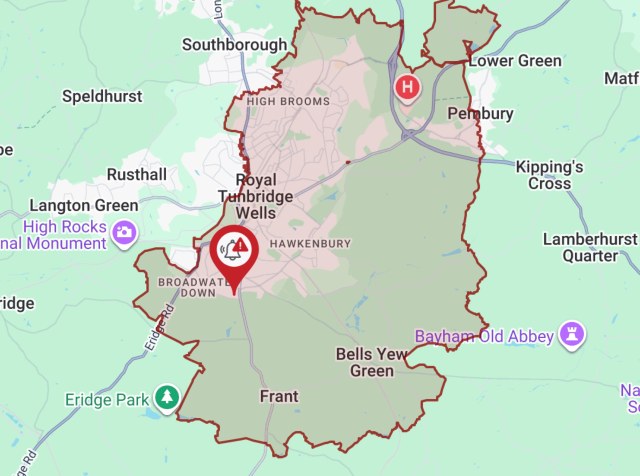
Mike Martin discussed the failures at the Pembury Water Treatment works which led to 50,000 people losing their drinking water for two weeks in December (area affected shown above).

Mike Martin revealed: I’ve pulled together a group of water experts to assess what needs to be done at Pembury to bring it up to scratch. To get over the under-investment backlog that we’ve suffered from for the last 20 years, it’s about 50 million quid.”

Mike Martin argued: “If they’d spent that money and it (Pembury water works) hadn’t fallen over, they wouldn’t be paying fines. They wouldn’t be paying 30 million in compensation and operational costs when they have an outage. Local businesses wouldn’t be losing out.”

Mike Martin continued: “So if you put them into SAR (Special Administrative Regime), when they fail their licence, then you force through rapid investment and upscaling in pinch points like Pembury Water Treatment Works. That is what would fix this system. Water treatment works by water treatment works, storage reservoir by storage reservoir.”

Mike Martin concluded: “The government has to get a grip and get a hold of these companies.”

Meanwhile, water industry expert Charles Hedges (pictured below) told Southborough News he was waiting for a full report from the Drinking Water Inspectorate on last year’s failures at Pembury Water Treatment Works before commenting in detail.

Charles Hedges said: “South East water needs to do two things. First, provide a comprehensive chronological description of all that has gone wrong since 9th of November. And the next thing, they they need to show an organisation chart that demonstrates they’ve got the skills to undertake the engineering works to rectify all the mistakes.”

The Interim Chief Executive of OFWAT, Chris Walters, was asked by the BBC on Thursday why the regulator’s report on the 2020-2023 failures had taken three years to produce.

Chris Walters replied: “Investigations do take time, especially investigations like this, because they involve a large amount of very complex, detailed engineering information that has to be very carefully assessed…We knew that we had to be specific and careful and detailed. So we didn’t make any slip ups, and we can do the best for customers.”

Chris Walters also rejected the suggestion that customers will end up paying South East Water’s fine: “We are proposing a £22 million fine. Crucially, that’s a fine that is paid by the company and its investors, not customers. It won’t show up on customer bills.”

Chris Walters continued: “The enforcement audit will require South East Water to take concrete, specific, legally enforcible steps to do better….South East Water needs to step up and take more ownership of the problem. Take the specific steps in the action plan and work more constructively with us and with other regulators in future.”

OFWAT has opened a new investigation into South East Water’s failure to supply drinking water in December and January.

It’s also been revealed that South East Water attempted to use the courts to stop OFWAT from announcing its proposed fine, arguing that releasing the news would have a serious impact on the the company’s reputation and its credit rating.

A judge threw out South East Water’s interim injunction at a hearing in the High Court on Monday.

According to a report on the website Kent Online, South East Water claimed OFWAT had “predetermined” its findings and argued the regulator’s decision was “legally-flawed” and “riddled with errors”.

Nicholas Gibson, representing the company at the High Court, argued its shareholders “target strong investment grade credit ratings” and that maintaining those “has been – and continues to be – challenging.”

A statement presented to the court by South East Water’s chief financial officer, Andrew Farmer (pictured below), said: “I consider it very likely that publication of OFWAT’s legally flawed proposed decision, and therefore the detailed findings in the 240-page decision, would seriously damage confidence in South East Water among those working in the finance sector with…very serious adverse consequences for South East Water’s business.”

Mr Farmer added the company feared OFWAT’s report being published would lead to a potential “downgrade” to its credit rating and make it “much harder for South East Water to secure the additional financing which it requires.”

In his judgment, Mr Justice Chamberlain said, that given its provisional findings, OFWAT was under a “statutory duty to publish.”

The judge called the company’s attempt to block publication to protect the company’s reputation with investors and “keep the credit ratings agencies in the dark” as “objectionable in principle.”

The judge added blocking publication would create a situation where the company’s credit ratings were based on “materially incomplete information.”

He said this would mean “potential lenders might enter into contracts which they would not otherwise have entered into and existing investors might decide to retain their investments in circumstances where they would otherwise have exited.”

Mr Justice Chamberlain also dismissed the company’s “objectionable” plea that the company “should be allowed to control when and to whom the proposed decision is disclosed.”

A spokesperson for South East Water said: “We recently filed for judicial review of an OFWAT draft decision and sought an injunction. Following a hearing, the court did not grant the interim injunction. We respect the court’s decision on this.”

South East Water concluded: “We are now considering OFWAT’s draft decision and will respond via the appropriate channels, ahead of its final decision. We have no further comment at this time.”